SBB Object Detection and Segmentation
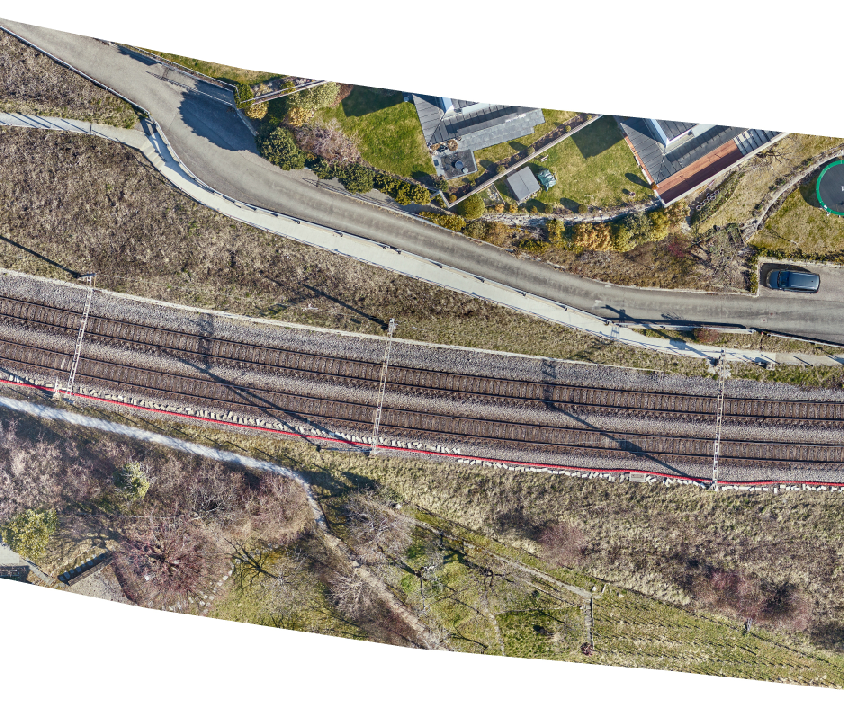

(Left) Image of SBB infrastructure acquired by a drone. (Right) 3D point cloud of SBB infrastructure acquired with a LiDAR.
The SBB has a very large infrastructure spread across the country, including rails, power lines, manholes, and hydrants. One of the key challenges consists of monitoring these assets, so as to ensure the operation of the Swiss railway. Recently, the SBB has turned to evaluating the use of drones for this task. As illustrated above, such drones acquire color images with regular cameras and 3D point clouds with a LiDAR. A crucial component to infrastructure monitoring then becomes detecting the objects of interest in this data.
The goal of this project is therefore to detect and segment SBB infrastructure items from drone images and point clouds. To this end, following the modern trends in Computer Vision, we will rely on a Deep Learning strategy. Depending on the precise objects to identify, we will investigate the use of different (instance-level) semantic segmentation algorithms, such as [1,2]. As these algorithms typically act on images only, one of the project's goals will be to extend them to exploit LiDAR data.
The chosen algorithm(s) will be evaluated on the database already acquired by the SBB. The project will be jointly supervised by Mathieu Salzmann and Mateusz Kozinski on the EPFL side, and by Arturo Vivas on the SBB one.
References:
[1] He et al., "Mask R-CNN", ICCV 2017.
[2] Ronneberger et al., "U-Net: Convolutional Networks for Biomedical Image Segmentation", MICCAI 2015.
Back to the project list.
The candidate should have Python programming experience. Previous experience with machine learning, particularly deep learning, is a plus.
30% Theory, 30% Implementation, 40% Research and Experiments